
Kenwood Press

Journey to Harvest
Squire Fridell
Spurrier and Gallagher personally selected the four chardonnays and four Bordeaux based on their quality and reputation.
The four French white wines (chardonnay)
Bâtard-Montrachet Ramonet- Prudhon, 1973. Montrachet, a highest ranking “Grand Cru” wine, has been the reigning sovereign of white Burgundies for centuries. (Alexandre Dumas of ‘The Three Musketeers’ said, “This wine should only be sipped while kneeling, with head bowed.”) Joseph Drouhin, Clos des Mouches, 1973, one of the most famous white Burgundies from the Beaune region.
Meursault Charmes Roulot, 1973, one of the most highly awarded wines from the Charmes area (one of Thomas Jefferson’s favorites).
Puligny-Montrachet Les Pucelles Domaine Leflaive, 1972. The vineyard dates back to 1580 and the wine is considered to be among the world’s greatest white wines. (One acclaimed wine writer labeled this “a ballerina of a wine, with enormous elegance, great depth, and magnificent fruit.”)
The four French red wines (Bordeaux)
Château Haut-Brion, 1970. This 15th-century estate is the second-oldest Bordeaux château and the only wine from the Graves district (the other three were from Mêdoc). The percentage of merlot in the wine is significantly more than any other of the four entries. In the famous 1855 Classification, Haut-Brion was awarded one of the four original “First Growth” wines of Bordeaux. (Thomas Jefferson, after visiting and tasting in 1787, called it “the very best of Bordeaux wine” and shipped some to his home in America.)
Château Léoville-Las-Cases, 1971. This 1855 “second growth” wine from St. Julien is considered to be the best of St. Julien and one of Mêdoc’s most outstanding wines.
Château Montrose, 1970. A highly-rated “second growth” from St.-Estêphe, the 1970 vintage was considered one of the best vintages of the previous quarter century.
Château Mouton Rothschild, 1970. Mouton was the most famous of the French wines in the tasting, largely due to its owner, the flamboyant Baron Philippe de Rothschild. Mouton was originally ranked a “second growth” in 1855, but was elevated to join the four “first growths” in 1973 and was the only re-classification since 1855.
The stage was set in Paris
Having secured the date, the location, the judges and the French wines, all that remained was the job of finding California wines that were good enough for the so-called competition. That job fell to Spurrier, so he asked his wife if she’d like to take a little vacation across the pond … and she said yes.
The next edition of the ‘Journey to Harvest … and Beyond: Judgement of Paris’ series will cover Spurrier’s selections of California wines and conclude with the judges’ results. Little did the distinguished judges know that the world of wine was about to be turned upside down.
“Kiss French but drink American.”
Anonymous Squire Fridell CEO, CFO, COO, EIEIO, Winemaker, Vineyard Manager & Janitor GlenLyon Winery Two Amigos Winery Glen Ellen, CA Sonoma Valley squire@glenlyonwinery.com
The Judgement of Paris: The background
Squire Fridell
Wine has been an essential part of the cultures and countries of Europe, dating back thousands of years before Christopher Columbus left Spain in 1492 to search of a western route to Asia. (Even though he ended up landing off the eastern shore of what became our United States, Columbus continued to insist he had landed in Asia until his death in 1506.)
Over subsequent voyages by others, the European community realized that Columbus had discovered a new continent, a “New World” that lay between Europe and Asia. For the following hundreds of years, many Europeans migrated across the Atlantic to begin a new life. Immigration became common with many of the settlers hailing from grape-growing countries bringing with them cuttings from the grapevines they had grown at home. (Unfortunately, those early plantings failed due to the severe winter months of America’s east coast.)
Over the next century, millions more European immigrants left their homelands for America in search of a new beginning. As the population grew and people moved further west, they settled, creating outposts and towns across this new land.
When gold was discovered at Sutter’s Mill in 1848, the rush further west to California was on, creating the most massive population shift in U.S. history. California’s population grew enormously and within two years, California became America’s 31st state.
Early Spanish missionaries had been planting grapevines for sacramental wine on this continent since the 16th century, but it wasn’t until 1769 that they began moving north into “Alta California,” building a total of 21 missions on their way. (Sonoma’s was the final mission built, begun under Spanish control but completed under Mexican rule.) Grapevines were planted at each mission to make wine for their religious ceremonies, but because of both the lack of winemaking skill and the planting of their traditional mission grape to make wine, the quality of the finished wine was poor.
As the new European immigrants (particularly from Italy) settled in California, they (as many had done before) planted their “old country” grapevines to make their wine. California’s mild weather proved to be a perfect spot for growing their vines.
Among those early settlers was Agoston Haraszthy, an enterprising immigrant from Hungary who made his way to Sonoma to build his home. He recognized the area’s potential for grape growing for wine and was one of the first to widely plant European varieties. In 1857, he built California’s first premium winery that he named “Buena Vista.” Others followed and the quality of the wine quickly improved to the point that California’s wines began to compete internationally. (In 1889, a wine from Livermore won the prestigious Grand Prix of Paris Exposition.) California wines were off and running and the stage was perfectly set for the future.
Just as California wines were gaining recognition domestically and abroad, a series of sequential catastrophes took place, which affected not only the world of wine, but the world at large.
Towards the end of the 19th century in both Europe and California, vast acreage of vineyards simply died for no apparent reason. After decades of devastation, a tiny insect (Phylloxera) was revealed as the culprit. Once the insect was found, botanists discovered that the insect had traveled to France on the roots of American plants during the exchange of grapevines, and a smattering of the almostmicroscopic critters were on the roots of the American varieties of vines. When the insect arrived in France, it began to voraciously feed on the roots of the French varieties. It took decades but once the cause was discovered, the preventive solution followed: using the rootstock of the “common” American vines (the insects did not prefer) and then grafting the fruit-producing French varieties at the top. The process was a rousing success; the diseased vines were destroyed, and new grafted vines (impervious to the insect) were planted, with no change in the finished wine’s quality. Worldwide, vineyards were replanted with the grafted, diseaseresistant vines.
Just after the Phylloxera problem was resolved and quality wines were once again being made, much of Europe erupted into a chain reaction of nationalistic events in 1914, resulting in World War I. By the time the aggressor, Germany, was defeated, and the war ended four years later, millions of lives had been lost, and the physical destruction it had brought to much of Europe was enormous. France was particularly hard hit with cities, towns and vineyards having been bombed continuously. (Champagne alone lost over half of the vineyards.) The economic destruction during and following the war would be felt worldwide for a long time….
Photo by Melania Mahoney
Domestically and just one year after the war ended, another disaster hit America: the U.S. Congress passed Prohibition, a misguided amendment to our Constitution, which banned the production and sale of alcoholic beverages. Smuggling, bootlegging, and widespread disregard for the law quickly followed, and regular consumption of wine in America abruptly stopped. It took 14 years before Prohibition was repealed, but the damage would last for decades. America’s heretofore fledgling wine industry simply disappeared.
Two more disasters coincided during this tumultuous time. In 1929, the stock market in America crashed, leading to a decade-long depression that proved to be the longest and deepest economic turndown in America’s modern history, eventually impacting every country globally. Unemployment was rampant, food lines were common, and any non-essential goods (certainly wine) were left by the wayside.
As the world eventually began to economically recover from the Depression, history seemed to repeat itself. In 1939, Germany invaded Poland, signaling the beginning of World War II. The world was at war once again, and would remain that way for six long years, until the defeat of the Axis forces in 1945.
At the conclusion of WWII, the ever-resilient French began to once again begin making their wines, and their wines, once again, took the podium as the standard bearers of world-wide quality and excellence. In California, a few historic wineries in Napa had reopened after the repeal of Prohibition, but the domestic market for California wine was small and its international market was non-existent.
Then, in 1966, an enthusiastic and ambitious Robert Mondavi built his winery, (the first large-scale winery erected in the 45+ years since Prohibition was made the law of the land). Mondavi, whenever asked, repeatedly would insist, (to anyone who would listen), that California’s wines could be on par with wines from anywhere in the world, including French wines. Wine writers, critics, (and certainly the French), condescendingly smiled and shook their collective heads in disbelief. The few wine drinkers in America continued to buy French wines.
Just ten years after Mondavi had built his winery in Oakville, the world’s perception of California wines was about to dramatically change. On a spring day in 1976, a seemingly innocuous event took place in Paris that forever changed the world of wine. It was called the Judgement of Paris.
Part 2 of this story will be in a future issue of the Kenwood Press. Squire Fridell CEO, CFO, COO, EIEIO, Winemaker, Vineyard Manager & Janitor GlenLyon Winery Two Amigos Winery Glen Ellen, CA Sonoma Valley squire@glenlyonwinery.com
Harvest & Crush 2025
Squire Fridell
Interesting to note that the words “harvest” and “crush” are often used interchangeably, but they are different. “Harvest” is when the grapes are picked off the vines, whereas “crush” begins when those grapes arrive at the winery to be processed into wine. (There is an old saying: “When the farmer picks the last of his grapes, his work may be over, but when those grapes arrive at the winery, the winemaker’s work has just begun. If you do both, you’re not too bright.”) There are many steps to help Mother Nature turn fresh grapes into wine, and numerous variations for each step (we’ve done many). This is what we now do at GlenLyon:
Step 1: Sorting
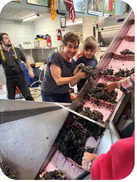
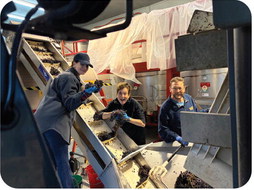
Using our trusty forklift, I weigh each macro bin of freshly picked grapes (1000+/lbs) then tip that fruit into the hopper attached to our elevator. As the grape clusters slowly travel up the elevator, WifeSuzy (Quality Control) and crew pick out any MOG (Material Other than Grapes). Many wineries do not take the time to do this step, but we feel it is important. Depending on whether we are processing red or white/ rosé grapes, different pieces of equipment are at the receiving end of that elevator.
Step 2: Processing
Red grapes are fermented on their skins (for color and character), so we use a “Destemmer” to eliminate the stems. (We can also attach our “Crusher” for the “bigger reds” like cabernet sauvignon but “crush” is a misnomer as it merely pops the berries. Regardless, red wine is fermented on the “must” consisting of berries, skins, seeds, pulp, and juice. We ferment our whites and rosé only on the juice, so we substitute machines to use our “bladder press,” a large, pressurized “colander” that squeezes the juice out of the solids.
Step 3: Fermentation
Whether it’s “must” (reds) or juice (whites/rosé) in the tank, we’ll add a yeast to start fermentation (this will happen naturally as yeast is on the grape skins but we choose to add specific yeasts for desired flavor profiles). As the yeast converts the sugars into alcohol, we’ll add specific products to encourage healthy fermentation. After one or two weeks of intense babysitting, the grape juice has been magically transformed into wine. If the red wine has been fermented as “must,” our bladder press then separates the wine from the remaining solids (now called “pomace”) but if the wine is white or rosé the skins and seeds were already eliminated prior to fermentation. Either way, we now have wine. At that point we’ll choose if we want that wine to “go through ML” (malolactic fermentation and a future KP article).
Step 4: Preservation
Wine is a food and food spoils. Wine spoilage can be due to many variables: temperature, exposure to oxygen, light, acidity, percentage of alcohol, tannins, residual sugars and/or age. The most proven way to protect wine from spoilage is the judicious use of sulfur dioxide (SO2) which kills undesirable yeasts and bacteria. Sulfur, a naturally occurring preservative, is Mother Nature’s way of protecting Her foods, and is found in almost all food. Winemakers usually add small, undetectable amounts to sure that their wines are protected. (“Sulfur-free wine” is misleading as all wine contains naturally occurring sulfites.)
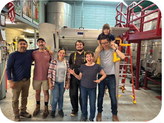
Step 5: Aging
At this point in the wine’s development the young wine needs time to develop and this aging process can last from months to years. (Remember how seasoned and grown-up you were when you were a teenager? Like you, the wine simply needs time to develop its character, stabilize and mature.
Step 6: Bottling
Wine is bottled when the winemaker feels the wine is ready to be consumed (or the bank balance is low). We schedule our bottlings one year in advance: March for our whites/rosé, and August for our reds. (I find bottling our wine is a bit like experiencing the wonder of birth. You’ve worked, prepared, worried and waited for that cherished moment when you can finally hold that little critter in your hands.)
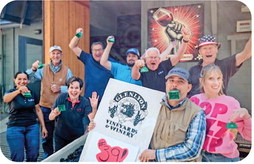
Here at GlenLyon, Harvest & Crush 2025 were eleven separate events, beginning with a joyous early morning harvest on September 12, 2025; and ending 44 days later on October 25, 2025. As I have said before, Mother Nature controls pretty much everything, and October 24 found Her a wee bit on the cranky side.
So … what happened on that “final day” of Harvest & Crush 2025?
We knew our “final day,” (October 24, a Friday) was going to be intense and complicated. Rain was threateningly intermittent, so we scheduled three different “days of work” for that Friday. It was going to be a long day, but knowing it was the final day, our trusty crew was up for it. Quite early we used our bladder press to successfully squeeze out the juice on our just-picked estate grenache (for rosé). Later that morning and after a thorough cleaning, we were on to job #2: to press a tank of red cabernet sauvignon, now finished with primary fermentation. Mission accomplished! As darkness was approaching, our final jobs were to quickly clean and set aside that equipment, then put our destemmer in place for processing a just-arrived grenache for red wine. Things were going well, and then … you guessed it! The world went dark!
PG&E insisted that it was a “temporary outage,” (we all know they are prone to fib), so we added dry ice to the covered grenache for CO2 protection, called it quits, had some dinner and a glass of fine Sonoma Valley wine, and got some sleep. Apparently (and as we slept) Dionysos went over Mother N’s head to chat with Her Mother (Gaia), and early the next morning the power had been miraculously restored. “Harvest 2025” may have been over on Friday, October 24, but with the help of two Saturday-available good friends (plus Dionysos, Gaia and Mother N) we were able to finish “Crush 2025” one day later. There will be months of winemaking in front of us, but “Harvest and Crush 2025” was finally put to bed!
As I type this mid-November, most of my days are still spent in the winery helping Mother N make her wine. By the time you read this column in December (if all goes well) all the eleven wines will be safely aging and maturing in barrels, awaiting bottling (and their birth) in 2026. Here’s to a wonder-filled 2026!
Squire Fridell, CEO, CFO, COO, EIEIO, WINO, Winemaker, Vineyard Manager & Janitor GlenLyon Winery & Two Amigos Winery Glen Ellen, CA Sonoma Valley, squire@glenlyonwinery.com
Photo by Melania Mahoney
KENWOOD PRESS #47 – March 1, 2025
IS WINE GOOD (OR BAD) FOR YOU?
Squire Fridell
Enter Mariano Guadalupe Vallejo!
We are dedicating a major portion of this Newsletter to respond to the US Surgeon General’s misguided proclamation.
Good News… Bad News… As a winemaker Squire has a certain bias…but he has written a well researched response about what our Surgeon General has stated (as fact) about alcohol.
WHAT’S THE BAD NEWS?
On January 3 the US Surgeon General, 47 year old Vivek Hallegere Murthy, made a startling proclamation: “just one drink (of alcohol) per week over a lifetime would raise your cancer risk significantly.
IS THERE GOOD NEWS?
A lot of it. Coincidentally, and just two weeks prior to the surgeon general’s damning edict, the National Academies of Sciences, Engineering, and Medicine (NASEM) completed an exhaustive scientific study on alcohol (Google “NASEM & Alcohol”). Their scholarly study examined the relationship between alcohol consumption and eight specific health outcomes, including cardiovascular disease, all-cause mortality, and certain types of cancer. I have summarized their “take home” conclusions below:
*All-Cause Mortality: Compared with never consuming alcohol, moderate drinking of alcohol will lower all-cause mortality. (You’ll live longer!)
*Cardiovascular disease: (You’ll be less likely to have heart problems!)
*Weight Changes: (You won’t gain weight if you drink moderate alcohol!)
*Neurocognition: The study found there was no association between moderate alcohol consumption and the risk of cognitive decline such as Alzheimer’s disease. (You can’t blame misplacing your car keys on last night’s glass of wine!)
*Cancer: There was no difference between non-drinkers and moderate drinkers for the risk of colorectal cancer. There did seem to be a correlation between female breast cancer and alcohol consumption, but only if higher amounts of alcohol were consumed. (Good reason to drink moderately!)
ANY OTHER GOOD NEWS?
*A few years back 60 MINUTES broadcast an episode entitled “The French Paradox” reporting that there was a 36% lower incidence of cardiovascular disease in French people than in their American counterparts. Even though both populations had a relatively high dietary intake of saturated fats, the apparent difference was that the French drank much more red wine than we do. (They still do!)
Just this past year, 60 MINUTES broadcast another positive piece on wine. Their well-documented “Mediterranean Dream Diet” episode concluded that wine with a meal could lead to a longer life.
WHAT’S FLAWED ABOUT THE SURGEON GENERAL’S EDICT?
The majority of scientific studies conclude that there are many possible benefits to moderate alcohol intake, the primary benefit would be lowering your risk of death. Why did our surgeon general make his anti-alcohol proclamation in spite of the overwhelming positive data (and just after the NASEM scientific study was published)? No one knows but the NASEM study was first to warn that “abstainer bias should always be considered”. (I’ll wager that our surgeon general is a non-drinker). They also correctly pointed out that in order to conduct any scientific study all of the criteria must be well defined. Unlike the NASEM study, he did not attempt to define “moderate consumption” nor did he consider life style, age, sex, socio-economic differences, diet, level of exercise or a host of other variables.
WHAT SHOULD I DO?
First: Just click on the Two Amigos home page www.twoamigoswines.com and read Squire’s complete article.
Life is filled with choices. Wine has been an important part of our existence for well over 8,000 years. I believe that we should eat well, drink well and enjoy every day to its fullest.
Raise a glass of fine Sonoma Valley wine tonight!
“Wine is sure proof that God loves us and wants us to be happy”
Benjamin Franklin
“No poem was ever written by a drinker of water”
Homer
“Wine is the most hygienic of all beverages”
Louis Pasteur
“If penicillin can cure those who are ill, good wine can bring the dead back to life”
Alexander Fleming
Squire Fridell
Winemaker, Vineyard Manager, CEO, CFO, COO, EIEIO, Wino & Janitor
GlenLyon Vineyards & Winery
Two Amigos Wines
KENWOOD PRESS – May 6, 2022
Journey to Harvest . . . and Beyond!
Monthly postings by Squire Fridell
Sonoma Valley… 200 Years of Growing Wine Grapes!
At the end of this month, the 127th Vintage Festival Weekend will be happening here in Sonoma Valley, celebrating the 200th year of growing wine grapes in our Valley. That’s right…200 years! Wow!
That would put the year at 1824 and, certainly, twenty decades is a reason to celebrate. That beginning year may have been a long time ago (even before I was born!) but it’s not the earliest record of California’s wine grape planting.
Before 1824…
Winemaking had been a common practice throughout Europe for thousands of years, but it wasn’t until relatively recently that grape growing and winemaking began on this continent. Until 1821, Mexico (and what is now Alabama, Arizona, California, Florida, Georgia, Mississippi, Montana, New Mexico, and Texas) were lands owned by Spain, a very religious country. The Spaniards began building missions (religious outposts) as far back as the 17th century in Baja California in order to “spread the Christian Gospel”. Along with each mission, the missionaries grew grapes for religious purposes as wine was a necessary element of holy communion.
In 1769, seven years before the signing of our Declaration of Independence, Spain began expanding north into “Alta California” to build even more missions. A religious priest by the name of Father Junipero Serra was dispatched by Spain to travel into this uncharted land, which later became “California.” His first stop was (what is now) San Diego and there, Father Serra built his first mission that he christened “Mission San Diego de Alcalá.” As that mission was being built, of course, Father Serra planted grapes to make the wine that was necessary for communion. When the wine experiment proved to be a resounding success, Father Serra was dispatched by his mother country to move further north. Mission San Juan Capistrano was built next, and they planted 2,000 grapevines at that site. Spain then tasked Father Serra to continue farther north and establish more missions. Serra eventually created eight missions during his lifetime. In total, 21 missions were constructed in Alta California, each with its own vineyard to produce wine for communion.
And then…
In 1823, the 21st and final mission, San Francisco Solano, was built just off the town square right here in our hometown. Our “Sonoma Mission” was the only mission of the 21 that was built under Mexican rule rather than Spanish, as Mexico had finally gained independence from Spain in 1821. Father José Altimira was the missionary responsible for the task and within one year, he had planted enough vines to produce 1,000 gallons of wine per year (certainly enough for communion!). Like all the missionaries and missions, the goal of the missions was to convert the indigenous population into baptized Christians. As we now know, there were many devastating results of those ill-guided intentions including tragic impacts on indigenous peoples and their cultures. (But that’s another story for another time…)

The Sonoma Mission

General Vallejo Statue on the Sonoma Square
Enter Mariano Guadalupe Vallejo!
In 1834, just ten years after Altimira had built his mission in our valley, two things happened that would forever change the world in which we now live. First, the Mexican government decided to appropriate and de-commission the mission and the vineyards began to grow fallow. Secondly, that same year the Mexican government assigned General Mariano Guadalupe Vallejo, the enterprising commandant of the Presidio in San Francisco, to command this rural “backward” village where the mission had been created. After Vallejo arrived with his family and took charge, he immediately went about building homes for himself and his large family and he began to lay out our Plaza, build barracks to house his troops, and design and name the streets in our town. (If you have not visited the barracks on our square or the beautifully restored “Vallejo homestead” not far from our plaza on Spain Street, I encourage you to do so.)
The saving grace was that Vallejo loved wine. Two years after he settled, he began to plant 20,000 grapevines to continue where the missionaries had left off, this time not planting grapes to make wine for communion but to enjoy wine as a commercial beverage. It proved to be a sound investment for him and by 1854, Vallejo’s wine had produced an income of $20,000 (a huge amount of money in those days). Vallejo’s brother Salvadore, also seeing profits, began planting additional vineyards east of Sonoma, one of which eventually became today’s Buena Vista. (Read the rest of our tumultuous, feast-to-famine history of wine in our Valley in my earlier “History of Wine” Kenwood Press articles.)
The Name “Sonoma”…
Vallejo was probably the first to use the word “Sonoma” as the name for his new pueblo. Even though it was disputed for years where the name originated, anthropologists now say that “Sonoma” is a compilation of two Wappo tribes’ words: “tso” meaning “earth” and “noma” meaning “home or village.” Put them together and say it fast and it comes out pretty close to “Sonoma.” There you go…. For over 150 years, we’ve also been known as The Valley of the Moon (another disputed origin) which became the popular novel penned by our own Jack London in 1913.
What Grape Varieties Did the Missionaries Plant?
The common variety that those missionaries planted for communion up and down our coast was a thickskinned, drought-tolerant, high-yielding red variety they called “the mission grape”. The grape’s origin is disputed but is closely related to varieties from Spain, Chile, and Argentina.
It is thought that the early missionaries had brought the grape cuttings with them from Spain (more dispute). As the missions moved up our coast and the acreage of grapevines for communion increased, cuttings from those early vines were propagated and traveled with the missionaries to the next site and planted. Even though the mission grape has pretty much disappeared from today’s vineyards, it’s interesting to note that up until 1880, it was the most common variety planted and grown in California. Unfortunately (or fortunately as we look back) about that time, a worldwide vine disease called phylloxera destroyed almost all of the grapevines in the world, Sonoma included. When the solution was discovered late in the 1800’s (grafting to resistant rootstock), we subsequently had discovered European varieties, and the mission grape was replaced with what we felt were higher-quality European grapes. (One of those original 18th century mission grapevines is located at the San Gabriel Mission. The rambling vine is affectionately known as “Vina Madre”).
Don’t miss the Sonoma Valley Vintage Festival, September 26 to 28, celebrating our 200 years of growing grapes for wine! Some events on Sept 28 are free, including the Blessing of the Grapes at 9:30 a.m. on the plaza, the Firefighter Water Fights following at 11 a.m., and the Artisan Festival on the plaza with live music, food, and wine from 10 a.m. to 4 p.m. Suzy and I will be at every event, so come up and say “Hi”!
“We are all mortal until that first kiss… or that second glass of wine.”
– Edwardo Galeano
“Men are like wine – some turn to vinegar, but the best improve with age.”
– Pope John XXIII
Squire Fridell
Winemaker, Vineyard Manager, CEO, CFO, COO, EIEIO, Wino & Janitor
GlenLyon Vineyards & Winery
Two Amigos Wines